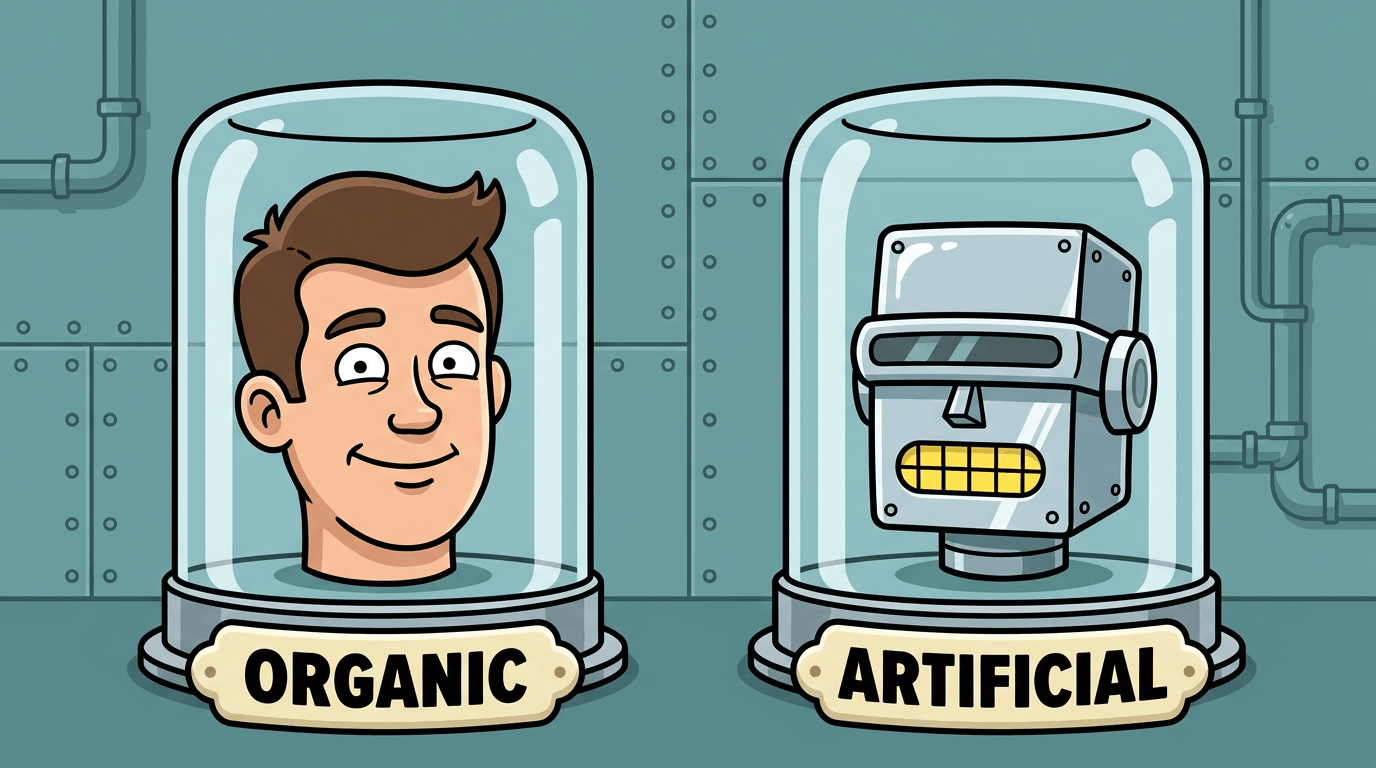
Organic vs artificial — the same head, two substrates.
Overview
Biology spent four billion years on one trick: organize information into nested layers, each doing a job for the one above — cell → tissue → organ → apparatus → body. Computing rebuilds that ladder from scratch, in hardware and in software. This is not loose analogy: the field of Artificial Life (aLife), from von Neumann’s self-replicating automata to Conway’s Game of Life, was founded on the claim that life is a property of organization, not of carbon. Push the comparison down far enough and the substrate vanishes — a strand of DNA is a four-symbol code, a transistor holds a bit, a neuron fires or it doesn’t. (See also What Is Information? and Turing-Complete: A Discovery Inherent to Reality.)
TL;DR — Organic and artificial life are one architecture in different materials. Read it up the ladder (cell → ecosystem) or across a single agent (sense, process, remember, decide, power, communicate); at the bottom both dissolve into information. Three parts: I — the ladder (by scale), II — the agent (by function), III — the thesis (why it’s all information).
At a Glance
The TL;DR is the gist; this is the whole map — every abstract function a living system performs, rebuilt in carbon and in code. The rest of the article is just this table, zoomed in.
| Abstract Function | Organic Life (carbon biology) | Artificial Life (digital aLife) |
|---|---|---|
| The core code | DNA & RNA (chemical bases) | Binary executables, scripts, core logic |
| Material substrate | Carbon, hydrogen, oxygen, water | Silicon, metallic circuitry, virtual memory |
| Energy ingestion | Eating, photosynthesis | Power outlets, cloud compute, battery |
| Energy distribution | Cardiovascular / circulatory system | Power cables, motherboard buses, power rails |
| Environmental input | Eyes, ears, touch, smell, taste | Cameras, microphones, LIDAR, web scrapers |
| Motor output | Muscles, tendons, skeleton | Robotic actuators, motors, screen displays |
| Algorithmic drift | Genetic mutation, breeding | Noise insertion, bit-flips, code merging |
| Population filtering | Natural selection (survival) | Fitness functions (deleting defective programs) |
| Defensive automation | White blood cells, antibodies | Cybersecurity agents, sanitizers, firewalls |
| Structural rebuilding | Cellular mitosis, tissue growth | Dynamic memory reallocation, self-healing code |
Two rows are the engine the rest depends on — algorithmic drift and population filtering together are evolution, the process that writes the code in the first place. The other eight are what that code, once written, builds and runs.
Part I — The Ladder: Cell to Ecosystem
The first axis is scale. Biology and computing stack the same rungs, and each rung is built twice — in wetware and in silicon — with each build split into hardware (the standing structure) and software (the pattern that runs on it).
The mapping
| Level | Organic · Hardware | Organic · Software | aLife · Hardware | aLife · Software | The Information Beneath |
|---|---|---|---|---|---|
| Cell | Membrane, organelles | DNA code, metabolism | Transistor / logic gate | Bit / instruction | One distinction: 0 / 1 |
| Tissue | Sheet of like cells | Shared contraction, signaling | Register, gate array | Data structure, function | A pattern: a word |
| Organ | Heart, eye, brain | Pumping, seeing, computing | Chip: CPU, GPU, RAM, sensor | Module, library, service | A transform |
| Apparatus (organ system) | Nervous, circulatory, digestive | Hormonal & neural signaling | Bus, memory hierarchy, I/O | OS, runtime, framework | A protocol / pipeline |
| Body (organism) | The physical organism | Physiology, behavior, mind | Device, robot, server | App, agent, OS image | An autonomous whole |
| Population / Ecosystem | Bodies in a group | Culture, gene flow, swarming | Networks, data centers | Distributed / multi-agent systems | A society |
Organic life has software too — DNA is code, hormones and nerve impulses are protocols — only fused so tightly to its wetware that we rarely name it apart. Each rung also has a role and a few reusable tags:
| Level | Category | Tags |
|---|---|---|
| Cell | Unit | atom · bit · gate · dna |
| Tissue | Group | pattern · structure · array |
| Organ | Function | component · module · service |
| Apparatus | Coordination | system · protocol · os |
| Body | Whole | organism · agent · machine |
| Population | Society | network · swarm · internet |
The roles are scale-free — Unit → Group → Function → Coordination → Whole → Society — in cells or in silicon.
Walking the ladder
Each rung adds one idea the rung below cannot express:
- Cell — the unit is already digital: DNA is a four-letter code at 2 bits per base, and Conway’s Game of Life shows three rules over identical cells suffice for full Turing-completeness.
- Tissue — identical units fall into a pattern; the pattern, not the material, is what matters.
- Organ — the first level where you can name a function without the wiring: “the eye sees,” “the parser parses.”
- Apparatus — organs cooperate by protocol (hormones, buses, network handshakes). Coordination is a protocol. (See Operating System Layer Stack.)
- Body — apparatuses integrate into one autonomous agent that acts on its own behalf — the threshold a single cell first crossed billions of years ago.
Beyond the body — populations and networks
The ladder does not stop at the organism. Bodies form populations, populations form ecosystems — and computing rhymes: a network is a population of machines, a data center a colony, the internet the planetary ecosystem. Distributed and multi-agent systems are swarms, producing behavior no single member intends. The structure is fractal: a body is an apparatus of organs, yet also a single “cell” in a network — the same pattern, one scale up.
And populations are where the code rewrites itself: random drift (mutation and breeding; noise, bit-flips, crossover) filtered by selection (survival, or a fitness function that deletes the weak). Evolution is not a biology-only trick — it is what any population of imperfect copies does, on genes or in a genetic algorithm.
Part II — The Agent: One Body and Its Functions
Part I climbed by scale. Hold one rung still — the body — and cut it the other way, by function: every complete agent, wet or dry, resolves into the same short list of subsystems.
The functional core
Strip an agent to what it cannot work without and you are left with an informational core — sense, process, remember, decide, regulate, power, communicate, self-maintain, and (to count as alive) replicate.
| Function (System) | Biological Analog | Robotic System | Category | Tags |
|---|---|---|---|---|
| Sensing / Perception | Sense organs — eyes, ears, skin, nose, vestibular balance | Sensor suite — cameras, microphones, LIDAR, IMU, tactile/force | Input | sense · perception · sensor |
| Processing / Cognition | Brain and central nervous system | Onboard computer — MCU, SoC, GPU / AI accelerator | Compute | cognition · compute · controller |
| Memory | Working and long-term memory; the genome as inherited memory | RAM and storage; maps, world-models, learned weights | State | memory · storage · model |
| Decision / Autonomy | Reflex arcs plus deliberation — the sense–think–act loop | The agent loop — perception → planning → control | Agency | agency · planning · behavior |
| Energy / Metabolism | Metabolism — respiration, digestion, circulation of fuel | Power system — battery, charging, power management | Power | energy · power · battery |
| Regulation / Homeostasis | Autonomic and endocrine feedback; thermoregulation | Feedback control, thermal management, watchdogs | Regulation | homeostasis · feedback · safety |
| Communication | Neural signaling, hormones, pheromones, language | Networking — buses, radios, protocols, telemetry | Comms | communication · network · protocol |
| Self-maintenance / Immunity | Immune system, healing, DNA error-correction | Fault detection, redundancy, self-diagnostics, ECC | Resilience | immunity · repair · fault-tolerance |
| Reproduction / Replication | Reproduction — copying the genome | Manufacturing / self-replication (von Neumann constructor) | Lifecycle | reproduction · replication · genome |
These nine are shared by a bacterium, an octopus, a human, and a Mars rover alike. What the core leaves out is the mechanical body plan, because it is not universal — a jellyfish has no bones, a plant no muscle, a bacterium neither limbs nor skeleton, yet each is a complete agent. So actuation, structure, manipulation, and locomotion are a second tier: optional tools.
| Capability | Biological Tool | Robotic Tool | Category | Tags |
|---|---|---|---|---|
| Actuation / Movement | Muscle, cilia, flagella | Motors, servos, hydraulics, artificial muscle | Tool | actuation · effector · optional |
| Structure / Support | Bone, exoskeleton, hydrostatic skeleton | Chassis, frame, housing | Tool | structure · chassis · optional |
| Manipulation | Hands, claws, beaks, tentacles | Grippers, arms, end-effectors | Tool | manipulation · gripper · optional |
| Locomotion | Legs, fins, wings | Wheels, tracks, rotors, legs | Tool | locomotion · mobility · optional |
The core decides and emits a command — pure information — and whether it drives a flagellum, a leg, a wheel, or nothing at all is a property of the tool bolted on, not of the agent.
A head without arms
The purest real example of a core without its tools is the AI assistant of the 2020s: a head without arms. It sees, hears, speaks, remembers, and reasons — yet cannot grasp a cup. Below, the organic head (a human) sits beside its aLife rebuild, each split into hardware and software. In wetware the two barely come apart — a neuron is its own program; in silicon they cleanly separate, and the software splits again into closed-source (rented via API — OpenAI, Anthropic, Google as one) and open-source (weights you host yourself).
| Faculty | Organic · Hardware | Organic · Software | aLife · Hardware | aLife · Software |
|---|---|---|---|---|
| Brain (reasoning) | Cerebral cortex, neurons | Thought, learned synapses | GPU · TPU · NPU | closed GPT-4o/5 · Claude · Gemini — open Llama · Qwen · DeepSeek |
| Sight (vision) | Eyes, retina | Phototransduction, visual cortex | Camera / image sensor | closed GPT-4o vision · Gemini — open LLaVA · Qwen-VL |
| Hearing (speech in) | Ears, cochlea | Auditory encoding | Microphone | closed cloud ASR (Chirp) — open Whisper |
| Voice (speech out) | Larynx, vocal cords | Speech, language | Speaker | closed Advanced Voice · Gemini audio — open Piper · Kokoro |
| Memory | Hippocampus | Engrams, memory traces | RAM + SSD / NVMe | closed hosted memory + retrieval — open vector DB + RAG |
| Runtime (serving) | Neural tissue (substrate) | Action potentials | CPU + accelerator | closed cloud API — open llama.cpp · vLLM · Ollama |
| Nerves (comms) | Nerves, axons | Nerve impulses | NIC · Wi-Fi · 5G modem | closed proprietary cloud — open HTTP · gRPC · MQTT |
| Power (metabolism) | Mitochondria, blood | Metabolic regulation | Battery / PSU | closed vendor BMS — open open BMS · RTOS |
| Arms (optional body) | Arms, hands, muscle | Motor control, reflexes | Actuators · motors | closed Gemini Robotics · Figure — open ROS 2 · OpenVLA · LeRobot |
Read down the aLife software column and you see the field’s tension: closed models lead today but are only ever rented — they vanish with the API key — while open models trail slightly yet are the only ones you can own: inspect, run offline, bolt to your own sensors and motors. (Snapshot, mid-2026.)
The reduction — head and mind as a stack
Reduce the head once more and even the sense organs fall away. What remains is a stack, the same layered architecture as an operating system, from the sensory surface down to the firing substrate — read each row as an abstract layer and the wet and dry columns say the same thing.
| Layer | Human Head / Mind | AI / Computational |
|---|---|---|
| Sensing | Eyes, ears, nose, tongue, skin | Cameras, microphones, sensors |
| Expression | Mouth, voice, facial muscles | Speakers / TTS, display |
| Transduction | Retina, cochlea, taste & smell receptors → spikes | Tokenizer, ADC, input encoder |
| Wiring | Cranial and peripheral nerves | Buses, drivers, I/O channels |
| Reflex | Brainstem, autonomic reflex arcs | Firmware, real-time loop |
| Perception | Sensory cortex — visual, auditory areas | Perception / encoder models |
| Cognition | Neocortex — language, reasoning, planning | The foundation model (LLM) |
| Representation | Grey matter — neuron populations | Network weights / parameters |
| Signal | Spikes — action potentials | Activations / tensors |
| Substrate (kernel) | Biochemistry, the connectome | Kernel / GPU runtime |
At the bottom both columns dissolve into one thing — a kernel shuffling information — which is where Part III begins.
Part III — The Thesis: Hardware, Software, and Information
One anatomy, two renderings
Biology makes the hardware/software cut with older words: hardware is anatomy (the genotype expressed as a standing body), software is physiology (metabolism, signaling, learning — the live process). DNA is the stored program; the cell’s machinery runs it — the genotype/phenotype duality von Neumann described as a self-copying universal constructor years before Watson and Crick found DNA doing exactly that.
And the seam is not a wall: an FPGA is hardware that rewrites itself from a description, and a brain rewires its own anatomy as it learns — software editing hardware. Two renderings of one continuous fabric.
Even all is information
- Biology is already digital. DNA is a discrete four-symbol code with error-correction and editing; the cell is a tape-reading, instruction-executing processor — Schrödinger guessed this in 1944, before anyone could read the tape.
- Computation is substrate-independent. A Turing machine does not care whether its tape is paper, silicon, or protein — which is why mapping cells to transistors works at all. Computation is a property of organization, not matter.
- Information is physical. Landauer showed that erasing a bit costs energy; Wheeler answered with “it from bit.” Shannon gave the unit — information as the reduction of uncertainty, the same currency for a hormone, a packet, or a spike train.
So the climb from cell to ecosystem is not a metaphor computing borrowed from biology — both are instances of one thing. Organic life is information organized in carbon and water; artificial life is the same information in silicon and code. Life is not a kind of matter but a kind of pattern, and patterns are made of nothing but information.
Further Reading
Related
- What Is Information? — data → information → knowledge
- Turing-Complete: A Discovery Inherent to Reality — computation as a property of the universe
- Operating System Layer Stack — the software apparatus, layer by layer
- History of Computing Timeline — how the hardware/software body was built
Elsewhere
- Conway’s Game of Life — life-like behavior from three rules over cells
- Von Neumann universal constructor — self-replication predicted before DNA
- Christopher Langton & Artificial Life — the founding claim that life is organization
- Genetic algorithm — evolution as a search and optimization method
- Shannon, A Mathematical Theory of Communication — the bit as the unit of information
- Landauer’s principle — why information is physical
- Wheeler, “It from Bit” — reality as information
- Subsumption architecture (Rodney Brooks) — robots as layered sense-act loops
- Homeostasis — the self-regulation core every agent shares